Docyt
AI bookkeeping automation for multi location businesses and the accounting firms that manage them.
What is Docyt?
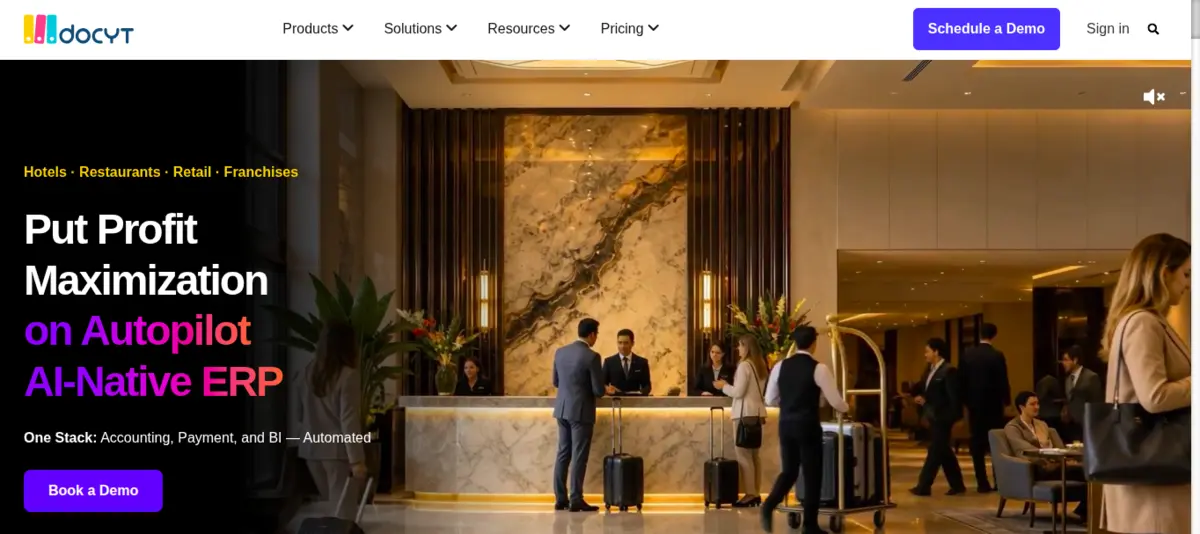
Docyt automates back-office bookkeeping for businesses that operate across multiple locations or entities. The platform captures receipts, invoices and other source documents - whether uploaded, emailed or photographed - then uses AI to extract data, code transactions to the correct accounts and reconcile them against bank and credit card feeds. Results sync back to QuickBooks, so Docyt acts as an automation layer on top of an existing ledger rather than replacing it entirely.
Where Docyt differentiates itself is in multi-entity consolidation. It rolls up financials across dozens or even hundreds of locations into unified reports, handling inter-company eliminations and location-level P&L breakdowns that QuickBooks alone struggles to produce cleanly. Revenue reconciliation is another focus area - the platform can ingest point-of-sale data from hospitality and retail systems and match it against deposits, tips and chargebacks automatically.
Docyt also runs an accounting firm partner programme, positioning itself as a tool that firms can white-label or co-sell when managing clients with complex, document-heavy operations.
Where it shines
The multi-location roll-up capability is the clearest differentiator. Franchise groups, hotel management companies and multi-unit restaurant operators typically face a painful choice between enterprise software that is expensive and heavyweight, or consumer-grade tools that require manual consolidation in spreadsheets. Docyt sits in between - affordable enough for mid-market operators but powerful enough to handle dozens of entities with location-level detail.
Revenue reconciliation for hospitality and retail deserves special mention. Matching POS settlements, third-party delivery payouts and tip distributions against bank deposits is tedious, error-prone work. Docyt automates much of this, which can save hours per location per month.
Document capture is solid. The platform handles a high volume of paper - receipts, vendor invoices, statements - and routes each item to the right entity and account with minimal manual intervention. For businesses still dealing with significant paper flow, this alone can justify the subscription.
The firm partner programme means accounting practices can layer Docyt into their service offering, which is appealing for firms that specialize in restaurants, hotels or franchise consulting. For firms exploring other automation-first bookkeeping platforms, Botkeeper offers a complementary approach oriented around outsourced bookkeeping rather than client-facing software.
Where it falls short
Onboarding is heavier than single-entity tools. Setting up chart-of-account mappings, POS integrations and multi-location hierarchies takes time and often requires hand-holding from the Docyt team. Businesses with one or two locations may find the setup disproportionate to the benefit.
The user interface feels dated compared to newer entrants in the bookkeeping space. Navigation can be unintuitive, and reporting customization options are limited. Teams accustomed to polished, modern dashboards may find the experience frustrating.
Because Docyt syncs to QuickBooks rather than replacing it, users are maintaining two systems. That dependency means QuickBooks subscription costs remain, and any sync issues create reconciliation headaches that can be difficult to diagnose.
Finally, Docyt is narrowly focused on its core verticals. Businesses outside hospitality, retail and franchising will find fewer pre-built workflows, and the platform is less useful for companies whose complexity comes from areas other than multi-location operations - such as manufacturing, construction or project-based billing.
Conclusion
Docyt fills a real gap for multi-location businesses drowning in receipts, POS reconciliations and entity-level reporting. It is not the prettiest tool and takes effort to set up, but for franchises, hotel groups and the accounting firms that serve them, the automation payoff is substantial. Single-entity businesses or those seeking a standalone ledger should look elsewhere, but operators managing ten or more locations will likely find the investment worthwhile.