Datarails
FP&A platform that keeps finance teams in Excel while automating consolidation, reporting and AI powered analysis underneath.
What is Datarails?
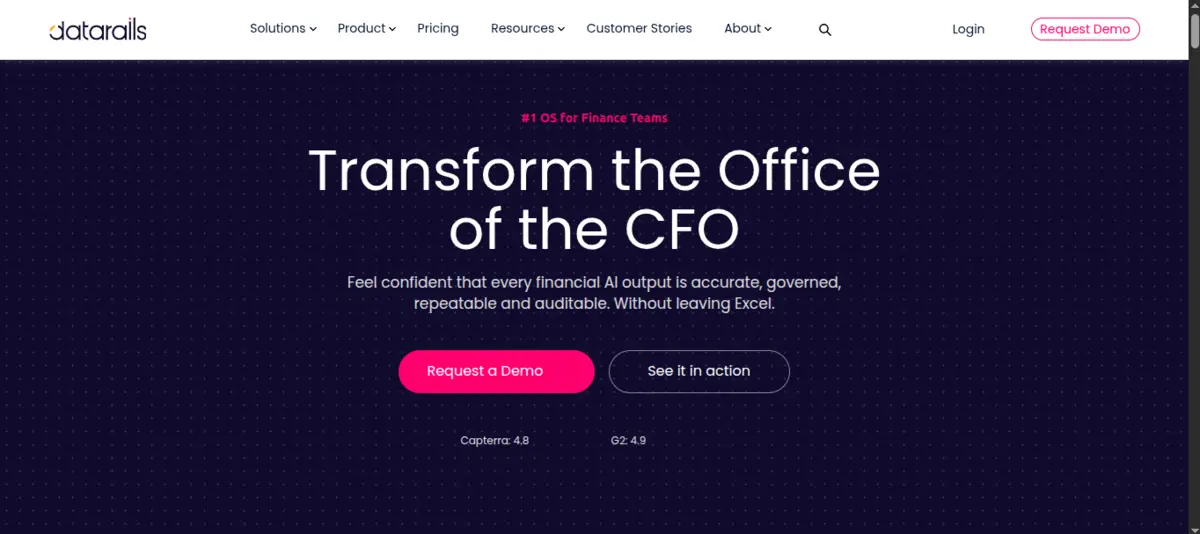
Datarails is a financial planning and analysis platform built around a single premise - finance teams should not have to leave Excel to get the benefits of a modern FP&A system. The platform connects to ERPs, CRMs, HRIS platforms and existing spreadsheets, consolidates the data into a governed central model and then lets teams continue building budgets, forecasts and reports in Excel with that data flowing in and out automatically.
Under the surface, Datarails provides version control and an audit trail for every spreadsheet that touches the platform. Each change is tracked, each version is saved and each data point can be traced back to its source system. This solves one of the most persistent problems in spreadsheet-based finance - the inability to answer “who changed this number and when” without digging through email attachments and file shares.
The platform also includes dashboards for visual reporting and a conversational AI feature that lets finance professionals ask questions about their data in plain language. Instead of writing formulas or building pivot tables to answer an ad hoc question, a user can type a query and receive a summary with supporting data.
Where it shines
Datarails’ strongest selling point is that it requires virtually no retraining. Finance teams keep their existing Excel models, templates and workflows intact. The platform adds a layer of automation and governance underneath without forcing anyone to learn a new interface or rebuild models in a proprietary tool. For teams that have invested years in complex Excel-based budgets and forecasts, this is a decisive advantage over platforms that require starting fresh.
The version control and audit trail capabilities address a real pain point. In a typical finance team, budget spreadsheets circulate via email, get modified by multiple people and end up in conflicting versions that are painful to reconcile. Datarails eliminates this by maintaining a single source of truth while letting everyone work in their own Excel environment. Every edit is logged, every version is recoverable and the consolidation happens automatically.
Data consolidation across sources is handled well. Datarails pulls from accounting systems like QuickBooks and NetSuite, CRM platforms like Salesforce, HRIS tools and of course the spreadsheets that finance teams already maintain. The consolidated model updates on schedule, so reports and dashboards always reflect current data without manual refresh cycles.
The conversational AI feature is genuinely useful for ad hoc analysis. Finance leaders preparing for a board meeting or responding to an executive’s question can get quick answers - “What drove the variance in marketing spend last quarter?” - without building a new report from scratch. The answers draw from the governed data model, so they are consistent with the numbers in the official reports.
Where it falls short
Datarails follows a quote-based enterprise pricing model, which means the cost is opaque until a sales conversation. For mid-market companies evaluating multiple FP&A options, the inability to estimate costs upfront can slow the decision process. The pricing generally positions Datarails in the mid-market and above, making it less accessible for smaller companies.
The platform is explicitly designed for teams that want to stay in Excel. Companies that are actively trying to move away from spreadsheet-based finance - perhaps toward a more collaborative, browser-native planning environment - will find Datarails reinforces the Excel dependency rather than reducing it. This is a feature, not a bug, for the target audience, but it is worth recognizing as a deliberate tradeoff.
Dashboards and visual reporting, while functional, are not the platform’s strength. Teams that prioritize polished, interactive dashboards for stakeholder consumption may find the visualization layer less refined than dedicated BI tools or FP&A platforms that were designed dashboard-first.
For finance teams open to working in Google Sheets as well as Excel, Cube offers a similar spreadsheet-native philosophy with broader spreadsheet platform support and a faster implementation path for smaller organizations.
Conclusion
Datarails is the best fit for mid-sized finance teams that have built their planning processes in Excel and need automation, governance and consolidation without disrupting what already works. The version control, audit trail and AI analysis features add meaningful value on top of the existing workflow rather than replacing it. Teams that see Excel as a limitation rather than a strength should look at alternatives, but for the many finance professionals who consider Excel their primary tool, Datarails makes it significantly more powerful.