Puzzle
Real time accounting software for startups, with automated categorisation and investor ready metrics.
What is Puzzle?
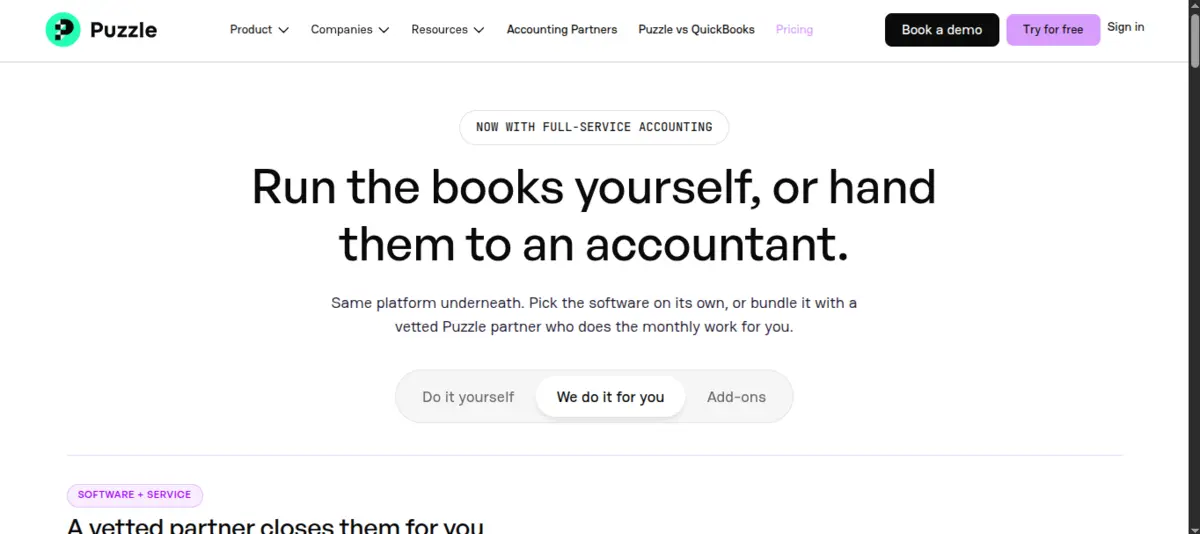
Puzzle connects to a startup’s bank accounts, credit cards, payroll providers and billing systems, then produces accrual-basis financial statements continuously using AI-powered categorization. Instead of waiting for a monthly close, founders and finance teams see an up-to-date income statement, balance sheet and cash flow statement that refresh as new transactions arrive. A metrics layer sits alongside the ledger, surfacing startup-specific KPIs - burn rate, runway, net revenue retention, gross margin - without requiring a separate analytics dashboard.
The platform is designed for collaboration between founders and their bookkeepers or accountants. Both parties work in the same environment, with role-based permissions that let the bookkeeper handle journal entries and reconciliation while the founder reviews high-level numbers and shares reports with investors.
Puzzle offers a generous free tier for early-stage companies, making it accessible before a startup has meaningful revenue or funding.
Where it shines
Proper accrual accounting is the most important technical differentiator. Many tools marketed to startups default to cash-basis reporting, which can misrepresent the financial picture - especially for SaaS companies with annual contracts or deferred revenue. Puzzle handles accrual entries automatically, which means the financials a startup shares with investors actually reflect economic reality rather than just cash movement.
Having startup metrics live next to the ledger is a significant convenience. Founders typically maintain a separate spreadsheet or dashboard to track burn and runway, pulling data from the accounting system manually. Puzzle eliminates that step, ensuring the metrics are always consistent with the underlying books. When a board member asks about runway, the answer comes from the same source of truth as the financial statements.
The free tier is genuinely generous. Pre-revenue startups and very early companies can use Puzzle without committing to a subscription, which removes a barrier that keeps many founders on spreadsheets longer than they should be. As the company grows and needs more integrations or support, paid tiers are available.
For teams comparing options, Digits offers another AI-native ledger with a focus on interactive reporting and accounting-firm collaboration, while QuickBooks Intuit Assist provides the broadest ecosystem of third-party integrations and professional support.
Where it falls short
Puzzle is designed for startups, and that focus comes with trade-offs. Traditional small businesses - a retail shop, a services firm, a restaurant - may find the metrics layer irrelevant and the feature set oriented toward problems they do not have. Inventory management, job costing and industry-specific workflows are not priorities for the platform.
Multi-entity consolidation and complex international structures are outside Puzzle’s current scope. A startup that grows into a holding-company structure or expands across several jurisdictions will eventually need to graduate to a platform built for that complexity.
The integration catalogue is growing but still smaller than what QuickBooks or Xero offer. Niche payroll providers, industry-specific billing tools or uncommon banking institutions may not have native connectors, requiring manual imports or workarounds.
Because Puzzle is a relatively young product, the community of accountants with deep Puzzle expertise is still developing. Firms accustomed to QuickBooks may need time to build confidence before recommending it to clients.
Conclusion
Puzzle is the best fit for early-stage startups that want real accounting - accrual-basis, investor-ready - without the overhead and cost of legacy software. The combination of automated categorization, continuous financials and built-in startup metrics addresses exactly what founding teams need during the first few years. Companies with complex inventory, multi-entity structures or deep reliance on niche integrations should look elsewhere, but for the startup segment Puzzle serves, it delivers a modern experience that spreadsheets and cash-basis tools simply cannot match.